
How to check my credit score
Your credit score is the number lenders use to size up your risk. Checking it regularly means you're never caught off guard by it, whether you're prepping for a big purchase or just keeping tabs on your finances.
This is general information, not personalized financial advice. Talk with a financial advisor or credit counselor for guidance specific to your situation.
Understanding the two main scores
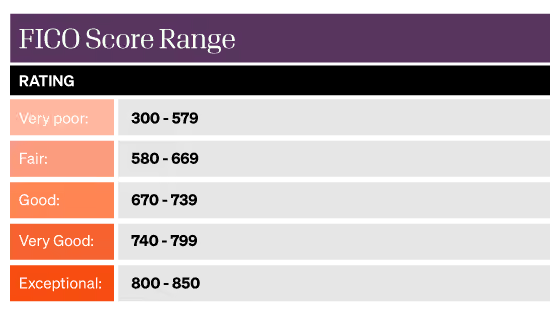
FICO scores break down like this:
- Very poor: 300-579
- Fair: 580-669
- Good: 670-739
- Very good: 740-799
- Exceptional: 800-850
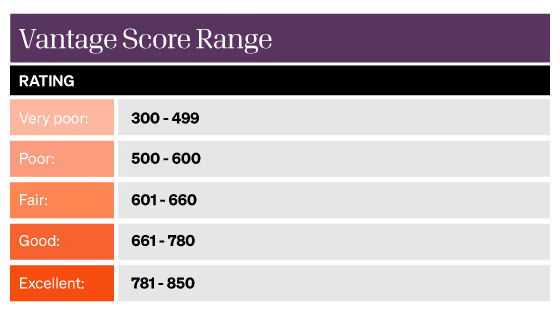
VantageScore, the other common model, uses a similar 300-850 scale but different breakpoints:
- Very poor: 300-499
- Poor: 500-600
- Fair: 601-660
- Good: 661-780
- Excellent: 781-850
Both scores aim to measure the same thing, but they're calculated differently, so don't be surprised if you don't see the same number from both.
Who's actually looking at these scores
FICO is the one most traditional lenders rely on: banks, credit unions, mortgage lenders, auto lenders, personal and student loan providers. It also shows up with landlords screening tenants, some insurers calculating premiums, and in a handful of states, employers reviewing candidates for finance-related roles.
VantageScore tends to show up with newer fintech lenders, some credit unions, and services that factor in alternative data like utility or phone payments — useful for people with a thin credit history. Some credit card issuers use both: one for the initial decision, another for ongoing monitoring.
Why bother checking it
A few concrete reasons this is worth doing regularly, not just before a big purchase:
- Catch errors early. Wrong payment history, an account that isn't yours, a debt attributed to the wrong person — all of these drag your score down until you dispute them.
- Spot identity theft. An unfamiliar account or a sudden spike in credit usage is often the first sign something's wrong.
- Know what you'll qualify for. Before applying for a mortgage, car loan, or apartment, knowing your score tells you roughly what terms to expect and whether it's worth waiting to improve it first.
- Track your own progress. Seeing the number move in response to your actual habits is one of the better ways to stay motivated.
What actually goes into the number
Both FICO and VantageScore weigh a similar set of factors, just with different emphasis:
Payment history. Late payments and collections hurt you; a consistent on-time record helps. Missing a payment by 30+ days is the kind of thing that shows up clearly here.
Credit utilization. Your balance relative to your limit. Owing $300 on a $1,000 limit (30% utilization) looks very different to a lender than owing $9,000 on a $10,000 limit (90%).
Length of credit history. Older, responsibly managed accounts help. An account opened last month doesn't carry the same weight as one you've had for a decade.
Credit mix. A mortgage, an auto loan, and a couple of credit cards shows you can manage different credit types. Relying on just one type is less favorable.
New credit. Applying for five cards in a month reads as risky. Going a couple years without a new application doesn't hurt you at all.
Public records. Bankruptcies and tax liens can seriously drag your score down. One correction worth knowing: civil judgments no longer appear on standard credit reports at all — the three major bureaus dropped them in 2017 under a nationwide settlement, since most judgments lack the identifying information now required for reporting.
Total amounts owed and recent activity. A large total balance, or a recent spike like maxing out a card, both signal higher risk even outside your utilization ratio specifically.
Credit inquiries. Every hard inquiry (a lender checking your credit for an application) can ding your score briefly. Multiple in a short window compound that effect.
How to actually check your score
Through your bank or credit card statement. Many issuers show your score free, monthly or quarterly, right in your online account. If you're already logging in to check your balance, it costs nothing extra to glance at your score too.
Through the credit bureaus directly. Experian, Equifax, and TransUnion each owe you one free credit report a year at AnnualCreditReport.com — note that this free report doesn't automatically include your score, though bureaus often sell one separately for a small fee, or you can find a free score elsewhere (see below).
Through free online services. Credit Karma, WalletHub, and Credit Sesame all offer free scores. These are useful for tracking trends, but the exact number can differ from what a specific lender sees, since these services often use their own model or a single bureau's data rather than what your mortgage lender will actually pull.
Through a non-profit credit counselor. A counselor can pull your reports, walk through what's helping or hurting your score, and check back in periodically as you work on it. This is a good option if you want more than just a number.
Whichever method you choose, avoid any site that asks for a credit card number in exchange for a "free" score. That's not how any legitimate service works.
Why your score isn't identical across bureaus
Small differences, often within about 20 points, are normal. Each bureau may have slightly different data on file (not every creditor reports to all three), and different scoring models weigh that data differently. A few points of difference won't change your overall tier. A gap of 50+ points is worth investigating for an error.
If your score is lower than you'd like
A few things actually move the needle:
- Pull your report and dispute errors. Wrong information can be dragging your score down for no reason.
- Automate your payments. On-time payment history is the single biggest factor in your score.
- Bring utilization down. Keep balances under 30% of your limit — on a $10,000 limit, that's staying under $3,000.
- Hold off on new applications. Fewer hard inquiries while you're rebuilding keeps the pressure off.
- Consider a secured card if you're starting fresh or rebuilding after damage.
- Keep old accounts open. Closing your oldest accounts shortens your credit history and can work against you.
- Talk to a non-profit credit counselor if you want personalized guidance working through debt and a plan to rebuild.
None of this moves fast. Expect real, durable improvement over a matter of months, not weeks, if you stay consistent.
Your credit score is a tool that lenders use to determine your creditworthiness. We'll teach you how (and why) to check it, as well as steps you can take to get the best score possible.
-1920x1080.avif)